Rethinking Dispute Resolution in Projects: Why Amicable Settlements Are the Future: Introducing CHOCOLATE Framework
Rethinking Dispute Resolution in Projects: Why Amicable Settlements Are the Future: Introducing CHOCOLATE Framework
In today’s complex world of infrastructure, construction, and large-scale projects, disputes are not just common—they are inevitable. Cost overruns, delays, design changes, and contractual ambiguities often bring parties into conflict. For decades, litigation and arbitration have been the default routes to resolving such disputes. While effective in delivering enforceable outcomes, they come with significant downsides: they are slow, expensive, and often destroy relationships in the process.
Is there a better way?
A growing body of professionals believes so. And this is where the amicable settlement approach comes in—a structured yet human-centered way of resolving conflicts before they escalate.
Why Traditional Methods Fail Projects
Courtrooms and arbitration panels are not built to preserve collaboration. Their purpose is to determine who is right and who is wrong, based on the letter of the contract and the law. But projects do not thrive on winning or losing—they thrive on completion, trust, and teamwork.
When disputes are escalated formally:
- Time is lost: Proceedings can stretch for months or years.
- Costs rise: Legal fees and expert witness expenses can exceed the dispute’s original value.
- Relationships break down: Parties who once collaborated become entrenched opponents.
For businesses, this is unsustainable. For society, especially in critical infrastructure, it delays much-needed progress.
The Amicable Settlement Advantage
An amicable settlement framework works on the principle of resolving disagreements before they harden into formal disputes. It is not about ignoring problems but about addressing them early, constructively, and transparently.
Key benefits include:
- Speed – Timelines are measured in weeks, not years.
- Cost-effectiveness – Processes are far less resource-intensive than litigation or arbitration.
- Preservation of trust – Solutions are built collaboratively, strengthening relationships rather than breaking them.
- Flexibility – The process can be adapted to short-term projects or long-term mega-developments.
- Win–Win outcomes – Rather than one side “winning,” both sides achieve a workable solution that allows the project to move forward.
Introducing a Practical Framework
In the newly published guide, a structured framework for amicable dispute resolution is presented that revolutionizes how professionals can approach conflict in projects.
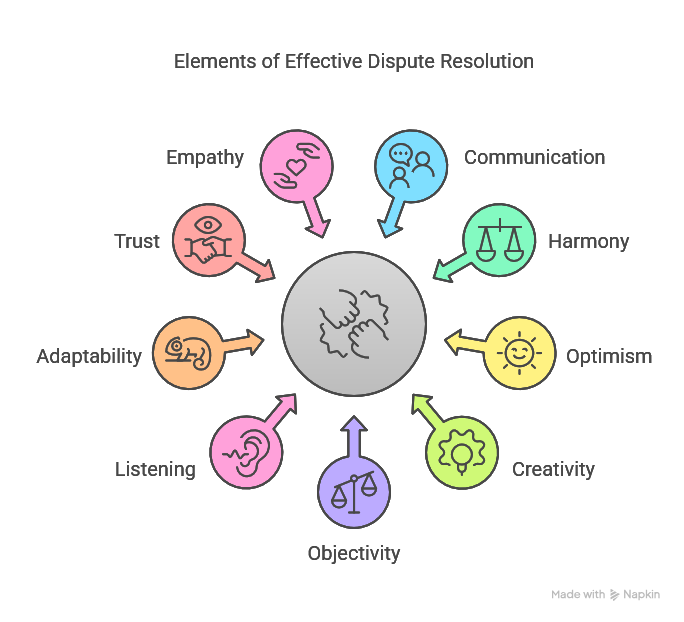
The framework—referred to as CHOCOLATE Principles—is built on clarity, honesty, objectivity, collaboration, openness, listening, accountability, transparency, and empathy. It provides:
- A step-by-step process to identify, address, and resolve disputes.
- Tailored timelines for short-term (under 6 months) and long-term (1 year+) projects.
- Case studies from real-world industries including construction, oil & gas, and technology.
- Sample contract clauses to integrate the process into agreements from day one.
This makes the methodology not only visionary but also immediately practical.
Â
Who Should Read This?
This approach is relevant for anyone who deals with projects, contracts, or negotiations, including:
ü Contractors and subcontractors
ü Project managers and engineers
ü Lawyers and contract administrators
ü Developers and investors
ü Policymakers and government authorities
Whether you are working on a billion-dollar infrastructure project or a small development, the principles remain the same: disputes don’t need to destroy value.
The global project landscape is becoming more complex. Supply chain disruptions, rising material costs, geopolitical risks, and environmental regulations all add layers of uncertainty. With more moving parts come more disagreements.
Waiting until disputes escalate into full-blown claims is no longer an option. Organizations that adopt amicable resolution processes gain a competitive advantage: they deliver projects faster, maintain stronger partnerships, and protect their reputations.
By embracing amicable settlements, guided by structured principles, professionals can save time, reduce costs, and preserve relationships. The impact is not just financial—it is cultural. It fosters a new way of thinking about business: one that values collaboration over confrontation.
The future of dispute resolution is here, and it begins with a simple but profound truth: before we fight, let’s talk.
Explore the complete framework and practical tools in the new guide, now available on https://www.amazon.com/dp/B0FMXCXM7X
Â
 
All Posts